
Globally, private credit has become one of the largest allocations in institutional portfolios. In the US and Europe it is a crowded, well-understood market. In recent years, concerns abound that these saturated markets have also created a bubble. China, which is the world's second-largest credit market, remains unfamiliar to most global allocators, even though ShoreVest's team has been investing in it since 2004.
That unfamiliarity tends to produce common misperceptions. For example, one is to equate China credit with the offshore dollar bonds of property developers, many of which defaulted after 2021. Another misperception is to assume that legal enforcement, repatriation and liquidity in China are simply unworkable for a foreign creditor. Neither of these misperceptions corresponds with reality on the ground in China.
This issue is a starting point for global allocators to gain a more accurate understanding of this space. It covers why private credit exists in China, the main ways investors have sought exposure, why some of them have worked and others have not, and what we think allocators should look for.[1]
A Market Built Around Commercial Banks
In China, a company seeking credit has few places to go. Commercial banks are the primary source, and their underwriting is rigid. In the US, banks provide less than a third of credit to the private non-financial sector, and in the euro area about half. In China, banks provide about 99%.[2]
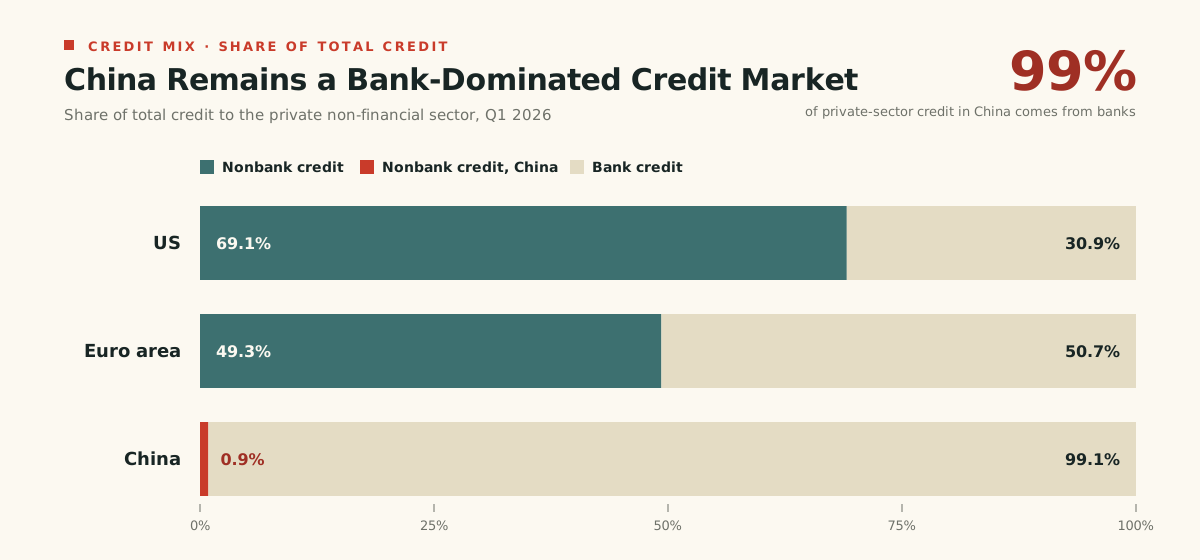
Several forces keep that gap open in China:
- Chinese banks favor state-owned enterprises. Private-sector borrowers face far more scrutiny and are chronically underserved, particularly when they fall outside a bank's standard criteria.
- The shadow banking channel was mostly closed. Until around 2017, wealth management products, trust loans and P2P platforms supplied trillions in nonbank credit, much of it funded by retail savers. Between 2017 and 2018, Beijing began to clamp down on the sector in order to mitigate the risks to retail investors, and off-balance-sheet risks to regulated financial institutions.[3] That left a large financing gap, estimated at about US$5 trillion—possibly one of the largest in the world.[4]
- Offshore bond markets have largely shut to most Chinese borrowers, and many private USD investors have retreated amid geopolitical uncertainty, as well as a realization that these ways of providing credit are unsecured.
- Domestic alternatives are thin. Few local institutions provide private credit with long-term, institutional capital. And this is why there is such dire need in China for groups like ShoreVest.
Five Exposure Entry Points, Three Have Worked
International investors have sought credit exposure to China through five broad entry points. They differ less in the borrower than in where the creditor sits relative to the collateral.
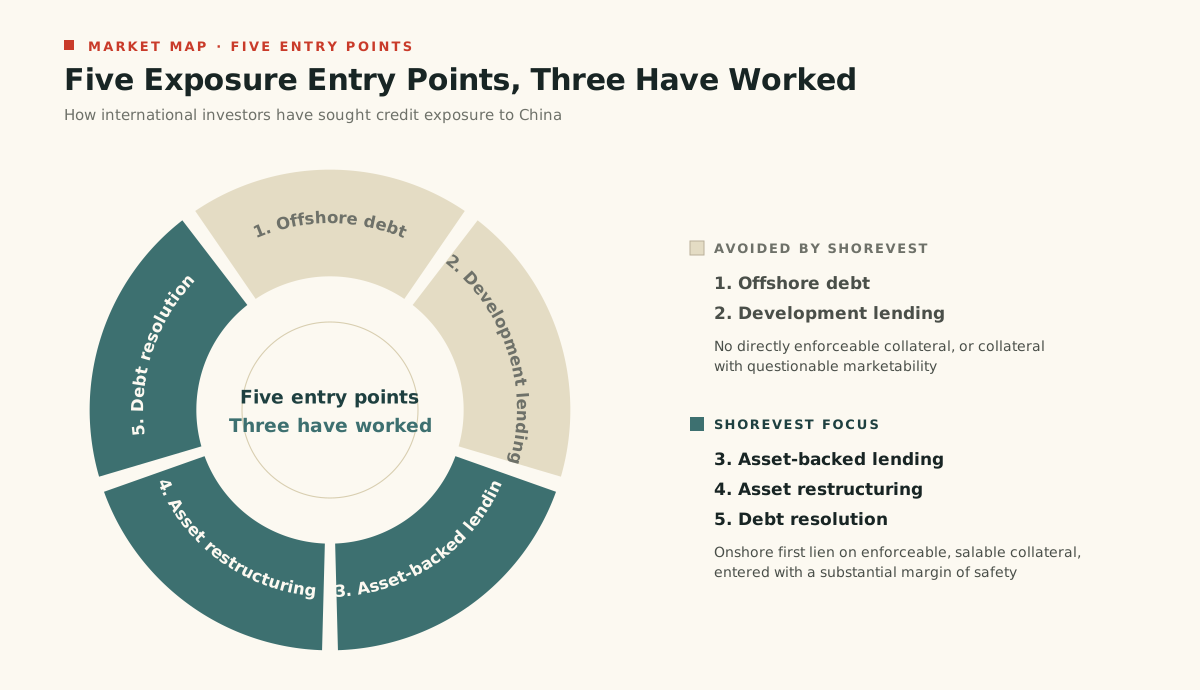
- 1. Offshore unsecured debt. Bonds or loans issued by an offshore entity, often in Hong Kong, to fund a Chinese business. The creditor has no direct, enforceable claim on onshore assets.
- 2. Property development loans. Onshore lending to developers, secured by land or unfinished buildings whose value depends on future construction and sales.
- 3. Asset-backed lending. Onshore, first-lien loans to performing companies outside property development, secured by completed, salable assets.
- 4. Asset restructuring. Loan-to-own transactions and other restructurings where a good asset sits inside a bad balance sheet.
- 5. Debt resolutions or NPLs. Buying nonperforming loans (NPLs) from banks and asset management companies at deep discounts, then recovering value through settlement, enforcement or sale.
The first two categories account for most of the losses that have shaped international perceptions of China credit. Offshore debt typically has no directly enforceable collateral. Development loans rely on collateral with questionable marketability. When the property cycle turned, both were exposed at the same time. ShoreVest does not invest in either.
The remaining three strategies share a common theme: (1) a first lien, (2) on enforceable, salable collateral, and (3) entered at a basis that leaves a substantial margin of safety. ShoreVest generally targets a loan-to-value or cost-to-value ratio of 30% to 60%, meaning collateral values can fall materially before principal is at risk. These three strategies are where ShoreVest has focused across more than 70 transactions over two decades.
Why Onshore Matters
Perhaps counterintuitively for foreign investors, a creditor holding onshore debt in mainland China with a direct first lien is usually in a stronger position than one holding debt structured in Hong Kong, the BVI or the Cayman Islands (even though these other jurisdictions mirror English law). Regardless of the system of laws in a given jurisdiction, offshore holding-company debt is structurally subordinated to the obligations of the onshore operating companies that actually own the assets. When things go wrong, the offshore creditor is an entire jurisdiction away from the collateral. We described this dynamic in our September 2021 issue, Evergrande: A Result of China Deleveraging and What Next, as the developer headed toward default and its offshore bondholders found themselves at the back of the line.
Onshore lending also allows protections that offshore structures rarely achieve. Beyond a first lien on hard assets, ShoreVest often takes personal guarantees, control of the borrower's bank accounts and company chops (the corporate seals that authorize transactions in China), and in some cases board seats or similar corporate governance measures.
Foreign managers can provide structured credit or lend onshore legally through established structures, including wholly foreign-owned enterprises, licensed SME lending companies and bank-entrusted loans. NPLs can be acquired directly from China's asset management companies (AMCs) with an NDRC filing, or through regulated asset exchanges with SAFE approval. Executing these structures well is a matter of experience on the ground rather than regulatory permission.
Does the Legal System Work?
China is a civil-law jurisdiction and has had creditor-rights and bankruptcy laws for decades. In the first NPL cycle of the mid-2000s, enforcement was slow and uncertain. That has changed substantially. Since 2017, Beijing has required courts to follow credit-enforcement timelines, with first-lien enforcement cases normally expected to conclude within 18 months, subject to exceptions. Judicial auctions must now be published online, widening the pool of bidders.
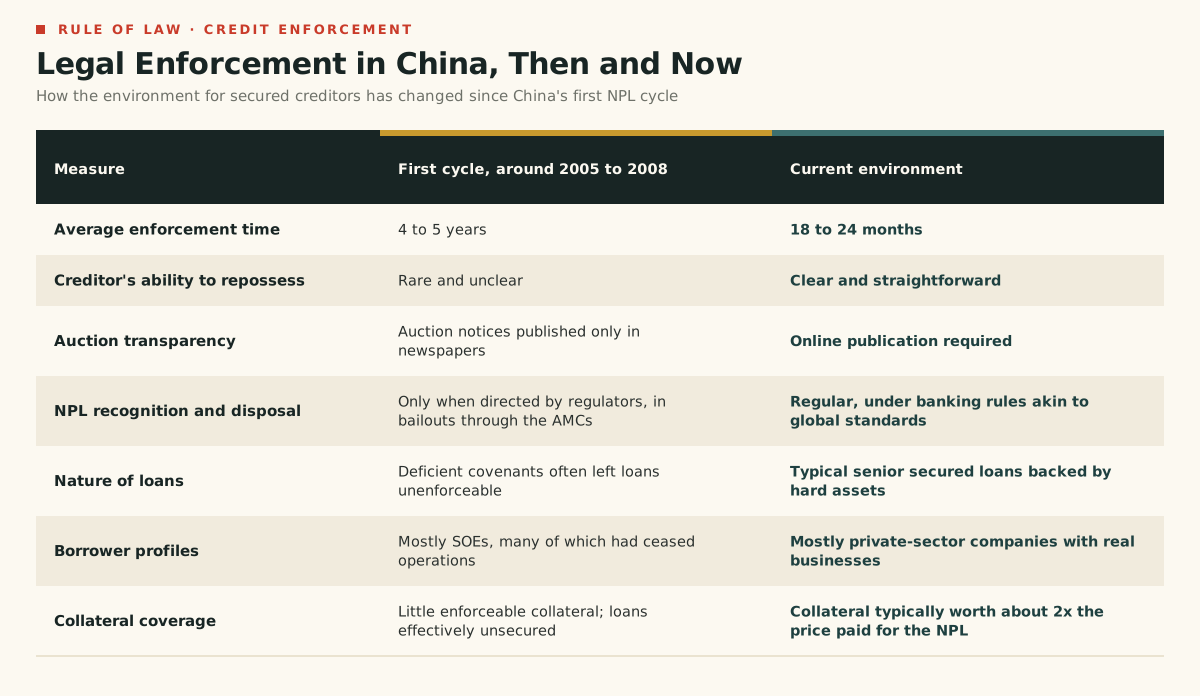
In ShoreVest's experience, credit enforcement in China is least predictable in three situations, each of which can be avoided:
- The credit is offshore. Unsecured debt issued outside the mainland is structurally remote from onshore assets.
- Enforcement would raise social-stability concerns. Courts may proceed cautiously where enforcement would cause widespread evictions or job losses.
- The investor lacks local experience. Foreign funds that parachute into China without an onshore team frequently encounter avoidable execution problems.
Even the fastest court process cannot help a creditor whose collateral attracts no bids at auction. That is why ShoreVest has avoided development lending since 2014 and favors completed, cash-flowing assets with recent comparable transactions. In practice, most situations resolve before auction: in asset-backed lending, in the last two decades, ShoreVest has needed to take only one borrower to court following a default, and won. In purchased NPLs, which are already in default at entry, most collections have been resolved through settlement, loan-to-own or sale of the loan or collateral. This of course depends on the liquidity of the underlying collateral and the deep-value entry price that produces a margin of safety, each of which ShoreVest vets extensively at the time of underwriting. Last month's issue, Perceptions Versus Reality in China Real Estate, looked more closely at why completed, income-producing commercial assets continue to transact even as residential development struggles.
Where the Premium Comes From
Returns in China private credit are typically higher than in more mature markets. But more importantly, the same conditions that create the premium also give the lender leverage to negotiate greater downside protection. The premium comes from three sources.
- Borrowers with few options. Companies that fall outside rigid bank criteria, whether for working capital, a bridge ahead of an IPO, or a refinancing to cure a cross-default, will pay for speed and flexibility, and will grant more collateral and guarantees to get it.
- Banks required to sell. China has pushed its banks to recognize and dispose of problem loans at unprecedented scale. As we detailed in Quantifying China's NPL Market, the banks have disposed of about RMB 3 trillion (roughly US$427 billion) of NPLs each year since 2019, in what is the world's largest NPL market.
- Complexity as a discount. A good asset trapped in a legal dispute, bankruptcy or NPL portfolio can often be acquired well below market value by a buyer able to resolve title, creditor claims and operations.
Competition for these situations is thin. Western and pan-Asian credit funds generally have limited onshore presence in mainland China, and domestic providers have had limited access to institutional long-term capital. Because returns are driven by domestic credit conditions rather than global cycles, the strategy has also shown low correlation with other credit markets; one MSCI factor-model analysis found an average correlation of about 0.11 between China credit and US, European, developed-market and emerging-market credit.[5]
Case Study | Wuhan Cold-Chain Warehouse
One investment ShoreVest made (and exited) that shows some of the elements of China private credit discussed above was in a cold-chain warehouse in Wuhan.
- A cold-chain logistics operator in Wuhan, one of China's largest transportation hubs, entered bankruptcy reorganization with first- and second-lien bank loans secured by its warehouse. Because this is what ShoreVest considers an 'all-weather' asset, and because liquidity for such assets was robust, ShoreVest viewed this as strong collateral.
- ShoreVest purchased both the first- and second-lien loans at a discount. With a buyer for the collateral identified before investing, the entry basis implied a loan-to-value ratio of about 11%.
- The investment has since been fully realized at a much higher return than typically seen in other private credit markets.
- The asset was never the problem. The balance sheet was. Resolving it required local legal, court and buyer relationships that few market participants have.
Getting Capital Back Out
A common question from global allocators is whether capital invested in China can be repatriated. ShoreVest has converted exit proceeds into USD and distributed them to investors for more than 20 years. The process depends on obtaining the required government approvals at entry and managing the administrative steps at exit, including taxes, audits and coordination with commercial banks.
In our experience, repatriation is most difficult for three groups:
- Foreign investors who closed deals in China without the proper government approvals.
- Foreign investors without an onshore team experienced in converting exit proceeds and moving them abroad.
- Domestic persons, such as individuals or state-owned enterprises, who are subject to limits on outbound transfers.
None of the above issues applies to an experienced China private credit investor, such as ShoreVest.
What Matters for Allocators
- Separate the strategy from the headline. 'China credit' is too broad to be an allocation decision. Offshore developer bonds and onshore first-lien loans are different risks.
- Insist on onshore, first-lien security. Proximity to enforceable collateral matters more than coupon.
- Underwrite the exit, not just the entry. Completed, cash-flowing collateral with recent comparable transactions supports multiple exit paths: repayment, settlement, sale of the loan, auction or loan-to-own.
- Demand a substantial margin of safety. Entry at 30% to 60% of realizable collateral value leaves room for both market declines and process delays.
- Look for a local team with a full credit cycle behind it. Enforcement, approvals and repatriation are execution skills learned on the ground.
The Bottom Line
China private credit is not a single bet on China's economy or its property market. It is a set of strategies with very different risk profiles than other forms of unsecured credit, and the difference lies largely in structure: where the creditor sits, what it holds as collateral and at what basis it entered.
For ShoreVest, the opportunity has always been in the onshore, asset-backed space of the market, where a bank-dominated financial system, a largely closed shadow banking channel, and record NPL disposals create steady demand for credit solutions that few competitors are positioned to supply. For allocators looking to diversify beyond increasingly crowded Western private credit, we think it deserves a closer look. For a quick overview, our new What Is China Private Credit page is a good place to start.
Sources and Notes
- [1] For a summary of China private credit, see ShoreVest, What Is China Private Credit. https://shorevest.com/china-private-credit/
- [2] Bank for International Settlements, Credit to the Non-Financial Sector statistics: total credit and bank credit to the private non-financial sector, adjusted for breaks, Q1 2026 (released September 14, 2026). Nonbank share calculated by ShoreVest as one minus bank credit divided by total credit: US 69.1%, euro area 49.3%, China 0.9%. https://data.bis.org/topics/TOTAL_CREDIT
- [3] Yinfa No. 106 [2018], Guiding Opinions of the People's Bank of China, China Banking and Insurance Regulatory Commission, China Securities Regulatory Commission, and State Administration of Foreign Exchange on Regulating the Asset Management Business of Financial Institutions, April 27, 2018.
- [4] State Council Information Office; China Banking and Insurance Regulatory Commission, 2022 to 2023; ShoreVest analysis.
- [5] MSCI Multi-Asset Class factor-model correlation matrix, May 2019. Average of China credit's correlations with emerging-market, developed-market, US high-yield, US investment-grade and European credit.