
As we observe the booming US private credit market from our perch here in China, we see multiple striking parallels with China's shadow banking system (non-bank lending), which ballooned by trillions of dollars before 2017. Between 2017-2018, Beijing clamped down on the space due to clear systemic risks. In contrast, despite US private credit's steadily expanding scale and weakening fundamentals, the US seems to be taking little action to mitigate the potential systemic risk. At this stage, we question whether the US will muster the discipline and regulatory coordination that Beijing showed.[1] Is a day of reckoning on the horizon for US private credit?[2]
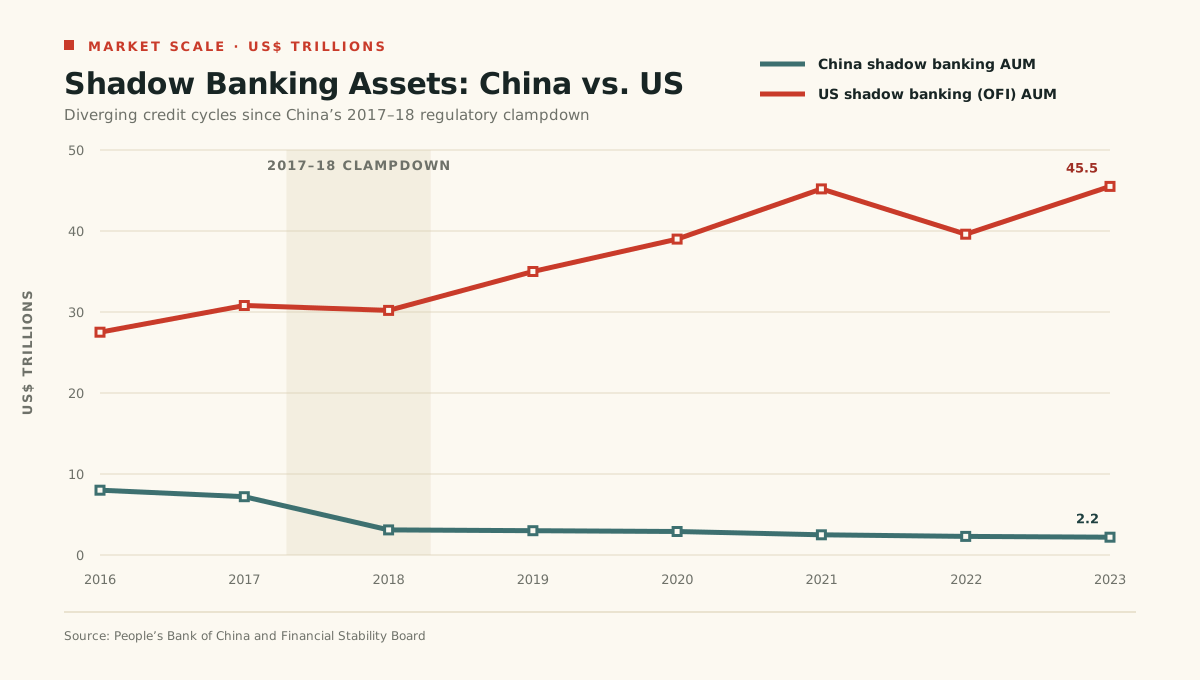
The credit cycles in the US and China often run counter to each other, and therefore are highly uncorrelated. In recent years, for instance, availability of credit from shadow banks to corporations in China has tightened dramatically, whereas the US has seen over 500 new private credit funds spring up since the 2008 global financial crisis (GFC).
While the flood of capital into US private credit has created overcompetition and weaker credit fundamentals for investors, Beijing's regulatory reform and shuttering of shadow lenders, such as wealth management products and P2P lenders, has created a vacuum of capital. This increases the attractiveness of China's market for locally experienced institutional private credit investors like ShoreVest.
In this piece, we elaborate on one thing we think is clear: explosive growth in unregulated US private credit is metastasizing systemic risks, while China continues to regulate its shadow banks, creating opportunities for institutional private credit outside its shadow banking sector.
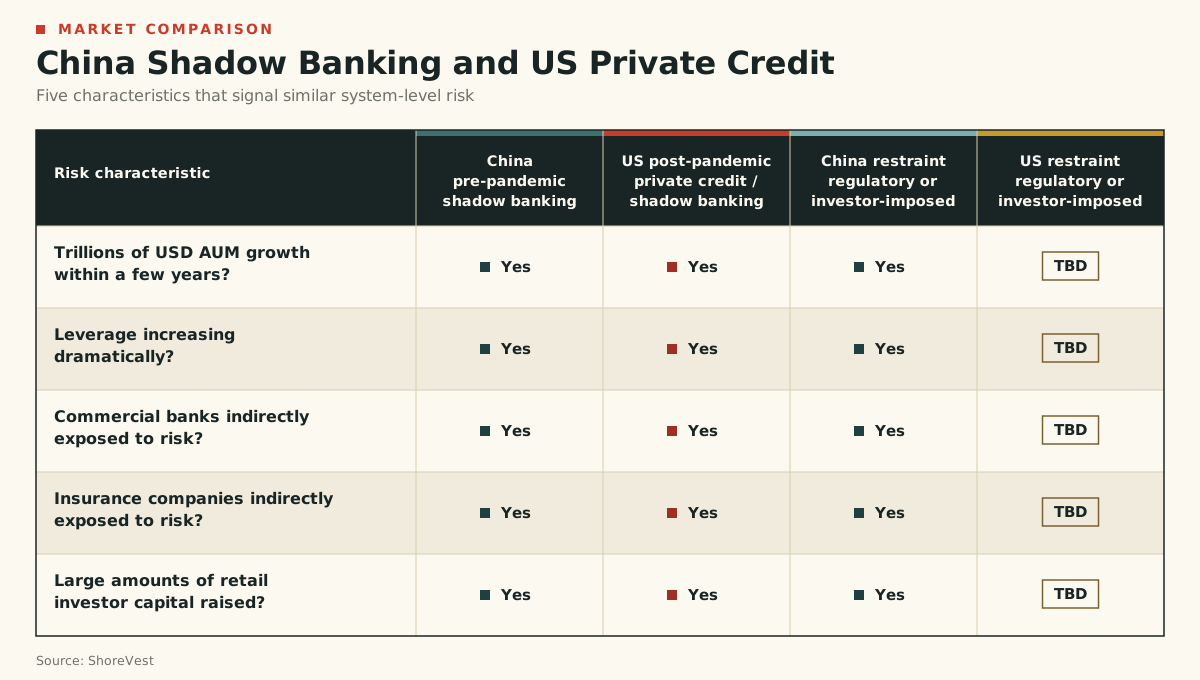
Before getting into the details, the comparison below sets out several areas where the current US private credit market mirrors China's pre-pandemic shadow banking space.
Lengthening Shadows
Booming US Private Credit
As investors in US private credit will recall, stringent banking regulations, namely the Volcker Rule and Basel III, instituted in the aftermath of the GFC forced US and European banks to disintermediate. Professionals departing the banks' proprietary desks set up direct lending funds outside the financial regulatory framework to lend to middle-market companies, facilitating private equity buyouts.
The flexible capital from direct lenders commanded a liquidity premium, attracting hordes of yield-chasing investors into direct lending funds in a zero- or low-interest era. As a result, over 500 direct lending funds were newly formed. Of US direct lending fund managers, less than 5% have experienced a credit cycle, the last one being the GFC in 2008, and less than 1% have a history in private credit as long as ShoreVest's team, at over 20 years.
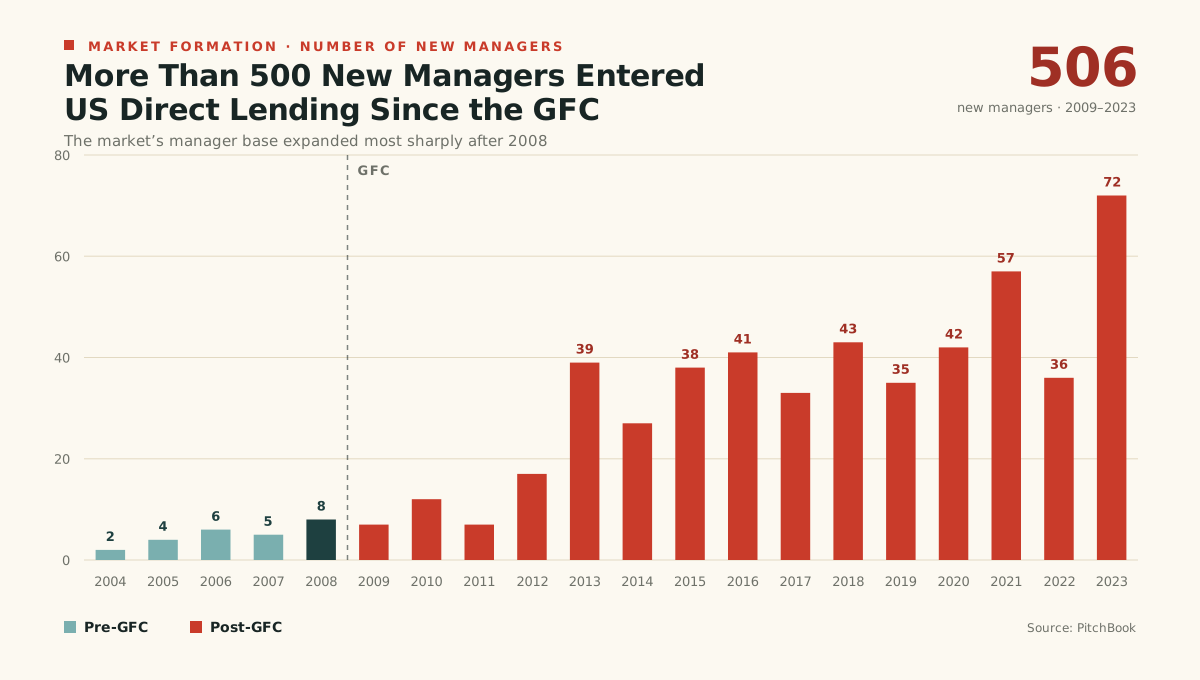
The symbiotic relationship between direct lenders and their private equity sponsors saw US shadow banking expand at a blistering pace, attracting investors to various forms of private credit, including mega direct lending funds, business development companies (BDCs), special situation hedge funds and others. The rapid growth has produced a number of issues for the US private credit space.
Struggling to Deploy and Exit
One major issue for US private credit is the massive amount of undeployed capital, or dry powder, which overhangs the industry. Due to the flood of new capital raised in the private credit space, most of which is in the US, around half a trillion dollars of dry powder has been awaiting deals for the last three years.[4] Inevitably, too much capital means compressed returns, but it also means less negotiating leverage to demand protective measures in credit instruments.
On top of the difficulties finding enough opportunities to invest in, challenges monetizing existing investments are arguably a bigger problem for US private credit. Cash distributions to paid-in capital (DPI) from private credit are at an all-time low as private equity-sponsored deals face a lack of exits through M&A and IPOs.
This has forced private credit managers to get creative in constructing new avenues to liquidity, which are arguably synthetic because they come from no real exit. Such avenues include selling portfolio positions in a rapidly developing GP-led secondary market, or setting up continuation funds to extend beyond the normal fund life, an indicator of more illiquidity in the foreseeable future. Other avenues create risks for banks, as discussed below.
Darkening Shadows
Beyond US private credit's existing challenges with deployment and exits, a number of broader and perhaps more concerning issues are appearing on the horizon.
Weakening Credit Fundamentals
Going forward, we think a higher-for-longer interest-rate regime is in the offing, driven primarily by a deteriorating US fiscal debt situation that is pushing up term premiums. In a stagflationary environment, higher interest rates compress operating margins, challenging debt servicing, especially for overlevered companies. This prompts them to use payments-in-kind (PIKs) to preserve cash, thus spiking loan-to-value ratios (LTVs).
Loose debt covenants have been increasingly salient in US private credit, and are more common in larger broadly syndicated loans (BSLs). They are triggering creditor-on-creditor violence. The market is also seeing substantially more liability management exercises (LMEs) to amend covenants, extend maturities, avoid formal defaults and essentially linger in zombie status.
Such LMEs may just be kicking the proverbial can down the road, only to default later. Recent studies by investment banks estimate that more than 60% of LME restructurings need a second restructuring within two years, as underlying operational issues are often left unaddressed. Although default rates are still low, the situation is grim amid growing economic uncertainty.
Even a few defaults in private credit funds might raise concerns about fund valuations given their illiquidity, infrequent marks and subjective models. Forward-looking cash flows become difficult to estimate if operating margins and interest coverage are cratering, and debt has increased through PIKs or LMEs. For context, 43% of mid-market firms tracked by S&P Global Ratings reported negative free operating cash flow in Q1 2025.
US private credit funds that adopted a covenant-lite approach to beat aggressive competition might find that weaker collateral requirements or lower-quality collateral face illiquidity in fire sales, to say nothing of unsecured private debt that has no collateral at all.
Double Exposure
Because many leveraged deals in US private credit involve a BSL underwritten by banks, and subsequently securitized in collateralized loan obligations (CLOs), together with a privately placed junior tranche held by private credit funds, if a US company falters, both bank loans and private credit investors are affected.
When an institutional investor, such as an insurance company or sovereign wealth fund, holds stakes in both the affected private credit fund and a CLO, losses in one investment may force the investor to liquidate assets elsewhere, propagating stress. Such risk correlations are growing as private credit funds expand in number and size, creating new interconnections through overlapping positions in club deals and co-investments shared by common LP investors.
Distressed Opportunity Unclear
Some US distressed debt managers paint the issues discussed above as an opportunity on the horizon. But if defaults pick up, it may be very difficult for US distressed funds to know whether they are catching a falling knife in the cycle that potentially unfolds. This seems apparent for a number of reasons:
- Global uncertainty arising from a multitude of geopolitical and macro factors will have a strong bearing on pricing and realizable valuations of distressed assets.
- US private debt that took off after the GFC has never experienced a downcycle, and therefore manager workout experience and capabilities are grossly lacking. More than 95% of direct lending managers were formed after the last US downcycle.
- Any systemic failures that require bailouts by a few large, long-standing managers could compromise those managers' ability to deliver optimal results because of unprecedented government pressures and intervention.
Interconnectedness in US Private Credit Enhances Systemic Risk
Systemic Risk
While immediate risks to private credit vehicles appear limited due to their long-term capital lockups, contagion from the interconnectedness between US shadow banking on the one hand, and commercial banks or insurance companies on the other, portends heightened systemic vulnerabilities. Systemic linkages may reduce the chance of a single point of failure, but could also allow many smaller failures to interact outside regulators' view.
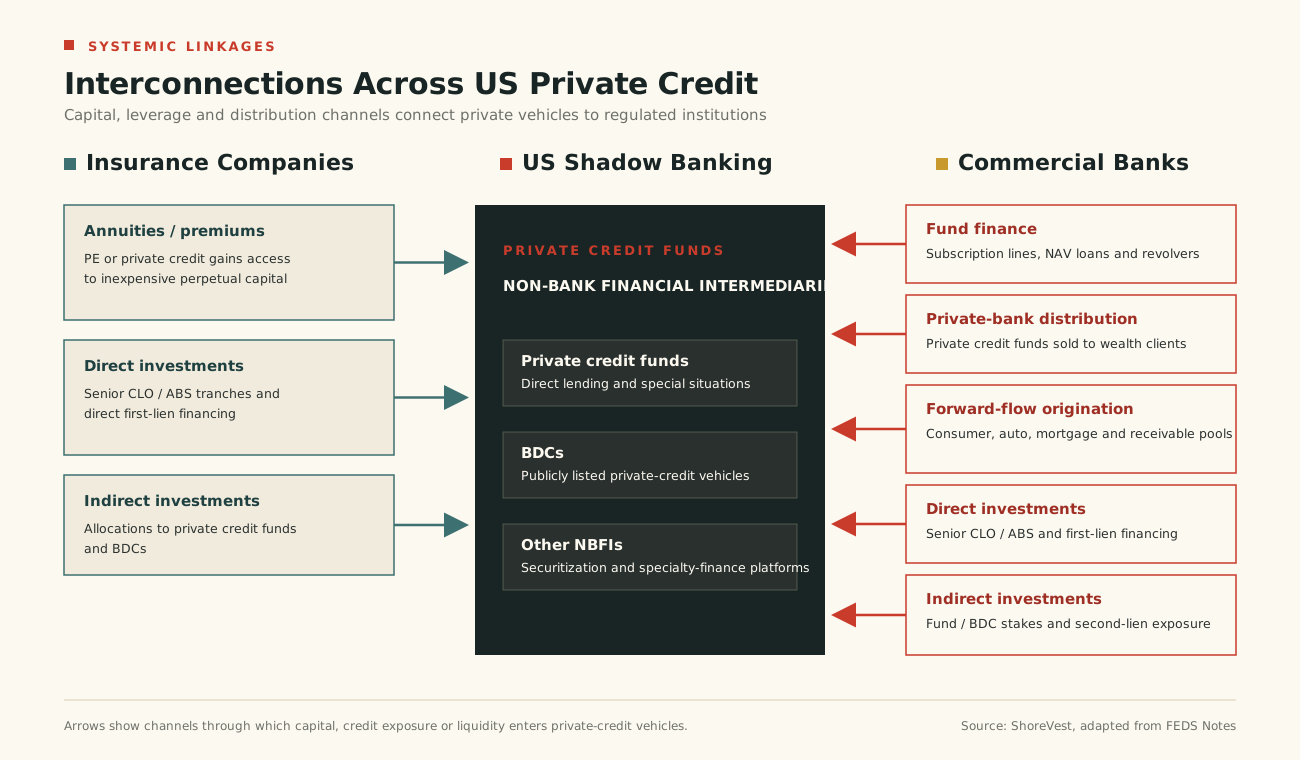
The graphic illustrates several ways in which the interconnectivity between US shadow banks and financial institutions is manifesting itself. Recognizing contagion risk, S&P Global Ratings, in its latest report on financial stability, highlights that hidden leverage in private credit carries potential negative knock-on effects that could disrupt the orderly functioning of markets. It therefore suggests that transparency and oversight applied to banks should also be applied to US shadow banking.[6]
Connectivity with Commercial Banks
As noted above, US private credit funds have resorted to various creative avenues to liquidity where no real underlying exit has occurred, such as continuation funds. A potentially more concerning avenue to such synthetic liquidity involves debt from banks, thus provoking systemic risk.
Private credit funds and BDCs are increasingly arranging revolving lines of credit and term loans from major US banks to fund distributions or inject cash into portfolio companies as business conditions sour.
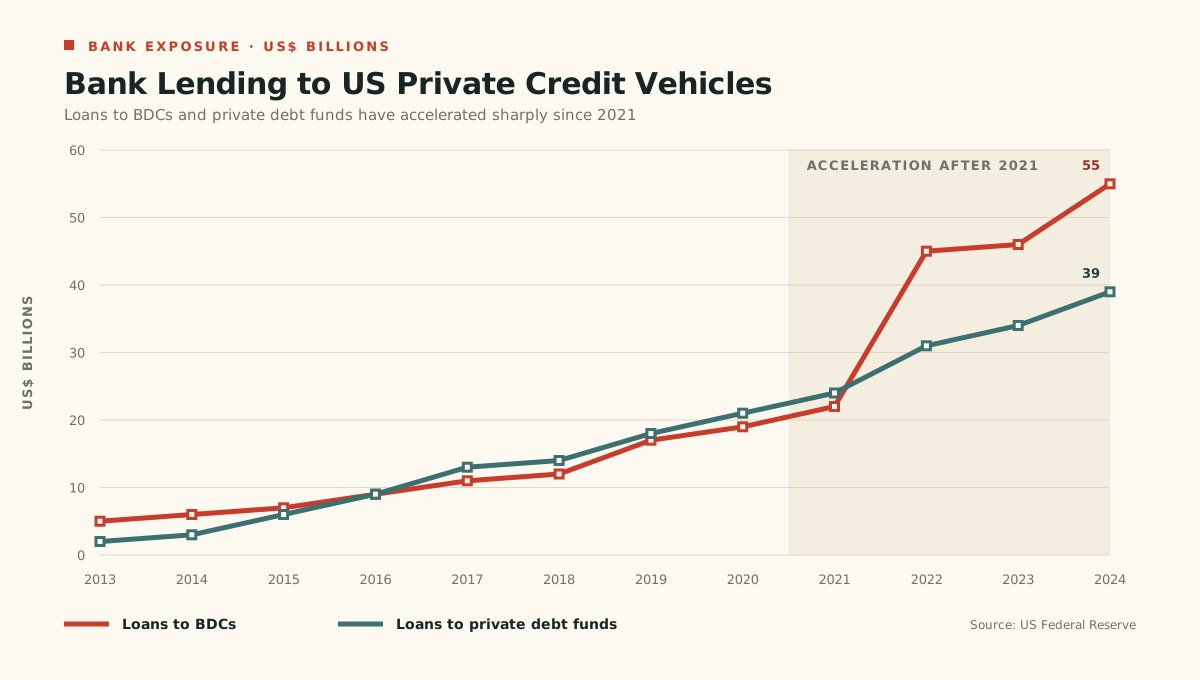
Funds that use leverage may face margin calls or lose access to funding lines, forcing increased liquidity demands from private debt vehicles.
US private credit is not only involving banks in its need for liquidity. Due to the massive overhang of dry powder discussed above, it is also involving banks in its need for deal sources. Large private credit managers are pushing into asset-based finance (ABF) by entering forward-flow arrangements with commercial banks to securitize pools of consumer and auto loans, residential mortgages and accounts receivable originated by the banks.
ABF has become the new catchphrase to attract large investments into senior-rated tranches of securitized asset pools from banks and insurance companies, thus importing the very risk they attempt to transfer to the marketplace.
Connectivity with Insurance
In addition to bank connectivity, the growing private credit-insurance nexus is equally concerning. US private equity is on a buying spree to acquire or forge partnerships with insurance companies, lured by the inexpensive leverage and perpetual capital that insurance premiums provide to portfolio companies and private credit businesses.
In some cases, mega private equity firms not only own insurance companies, but create and originate private credit products for their captive insurers to purchase.[7] According to AM Best and Moody's, over 20% of the US insurance industry's total assets are in private credit holdings, including CLOs, direct lending and asset-backed securities.
As the Bank for International Settlements put it in its 2024 annual report, losses in private markets could propagate risks across an increasingly interconnected and complex insurance landscape.
Chasing Retail Investors
Tapped out of institutional markets for lack of distributions, private credit is also aggressively making a beeline for private wealth, either through commercial bank-connected private banks or directly to retail investors. This is a movie we have seen before in China, and one that does not end well, as also echoed by Moody's.[8] Some veteran bond investors have compared the excitement around US private credit with the exuberance that surrounded collateralized debt obligations in the years leading to the 2008 financial crisis.
Even without a major event triggering mass defaults or a systemic crisis, investors in US private credit still feel the pain as fund managers distribute very little cash relative to historic levels. The ability of a closed-end private credit fund to extend and pretend, and thereby avoid a loss-realization event, does not remove the ultimate underlying problem.
Rather, it means that just as Japan created zombie banks in the 1990s through a general unwillingness to recognize losses, over time US private credit could find itself full of zombie funds extending terms indefinitely.
Lessons from China's Shadow Banking
US private credit's growing interconnectivity with banks and insurance companies, and its beeline for private wealth, all remind us of the proliferation of wealth management products, P2P lending firms, trust accounts and bank-entrusted loans in China's shadow banking system prior to Beijing's 2017-2018 clampdown.
Similar to the present-day US, China's banks and insurance companies took off-balance-sheet indirect credit risk in shadow banking. These risks were compounded by the fact that China's shadow banks raised massive amounts of capital from unsophisticated retail investors, mirrored today by US private credit's focus on private wealth.
Recognizing the lurking dangers of systemic risk from off-balance-sheet finance in its commercial banks, as well as risk transferred to unsophisticated retail investors, China proactively cracked down on the entire shadow banking sector in 2017-2018.
To mitigate such growing systemic risks, China's four leading regulatory bodies proactively adopted unified standards and rules greatly restraining asset management of the kinds found in the shadow banking system.[9] The regulatory bodies stipulated that private investment funds and certain areas of shadow banking would be governed more tightly by new laws and administrative regulations. Some noteworthy rules in China that we think could be relevant to today's US private credit industry are:
- A financial institution, such as a bank, shall not invest directly into the funds of its asset management products, meaning off-balance-sheet shadow banking analogous to US private credit funds, or in the credit assets of other commercial banks, such as consumer, auto or corporate loans.
- A financial institution is prohibited from providing any direct or indirect undertaking of, or otherwise bearing risks on behalf of, non-standard debt assets, such as private debt, invested in by an asset management product.
- The leverage ratio, measured as total assets divided by net assets, of a closed-end publicly or privately offered asset management product is capped at 200% of its net assets, and a unified maximum leverage ratio applies to products of the same kind.
- Banks cannot provide implicit guarantees to any asset management product, or to businesses that a commercial bank and asset management arm might undertake together. Banks also cannot use trusts to engage in regulatory arbitrage.
- Each financial regulation department shall submit data on asset management products issued by financial institutions to the People's Bank of China, communicating information about material cross-industry or cross-market risks.
In sharp contrast, we find that the current US government is shying away from addressing potential systemic risks[10] and indirectly encouraging large asset managers to gather assets in retail private credit products,[11] just as institutional channels are drying up.
Regulatory Discipline Means Better Private Credit Opportunity
It is a commonly accepted axiom that more competing capital usually means lower returns. But an often overlooked corollary is that more competing capital also means lower margins of safety, less negotiating leverage and weaker credit protections in a deal.
Just as a flood of capital into US private credit has deteriorated both returns and risk mitigants, China has experienced the opposite environment, in which regulatory restraints on shadow banking have made private credit more attractive, both in terms of returns and available risk mitigants.
From ShoreVest's experience executing private credit strategies in China for over two decades, we think proactive regulation fosters investment discipline among market participants and distinguishes astute investment and risk managers from asset gatherers and untested new players.
As Beijing's regulatory clampdown on China's shadow banks shut off unorganized alternative credit channels and untested new market entrants, this precipitated a historically unparalleled opportunity for long-term institutional credit providers with local experience.
To avoid the excesses of shadow banking, executing private credit strategies like ShoreVest's involves obtaining clear regulatory approvals from bodies such as the NDRC, structuring first liens on borrower assets, and exercising creditor rights within a well-established legal framework, unlike the nascent and untested bankruptcy rules in India, another active private credit market of late.
When done through time-tested institutional managers, private credit is recognized approvingly by China's regulators as a risk-mitigating channel to delever and clean up bank balance sheets, as well as fuel growth with institutional credit alternatives to banks.
Regulations limiting non-institutional shadow banking have opened a wide range of asset-based lending opportunities to institutional funds like ShoreVest, both in traditional hard-asset industries such as manufacturing and in new-economy industries such as renewable energy, electric vehicles, data centers, ecommerce and smart manufacturing.
Furthermore, because China has in recent years forced its banks to recognize non-performing loans (NPLs) at an unprecedented scale and speed, there is a significant opportunity to engage in debt restructurings of problematic loans on otherwise good assets.
China private credit has not experienced the same slow cash recovery or DPI issues seen in US private credit because China's non-sponsored, asset-backed private credit opportunities have multiple pathways to exit that are not predicated on capital-market conditions.
These include repayment by a profitable borrower, liquidation of collateral on which the debt has a first lien, sale of the debt to another investor, or taking ownership of the collateral in a loan-to-own transaction, each of which ShoreVest regularly does. This availability of multiple exit avenues contrasts with US private credit, which is often tied inextricably to sponsored deals that depend on conducive public markets to realize cash.
We believe that global allocators to private credit should watch US shadow banking's growing threat to the US financial system, as echoed by various industry participants. Concurrently, the allure of US exceptionalism is fading as investors increasingly diversify away from allocations to US equities, and even traditional safe havens such as US Treasuries, toward more global opportunities.
In this environment, the appeal of contractual and collateral-based yield should prompt investors to explore uncorrelated private credit opportunities in less-trafficked areas of the world such as China, where private credit is a solution for the real economy and not a shadow banking threat to the financial system.
Sources and Notes
- [1] The SEC attempted to tighten rules on private fund disclosures and valuation oversight, but the rules were struck down in full by the courts in 2024. SEC, 2023.
- [2] ShoreVest is not the only one asking. In 2025, pieces analyzing the question were written by the US Federal Reserve, the Federal Reserve Bank of Boston, Moody's and others.
- [3] Financial Stability Board, Global Monitoring Report on Non-Bank Financial Intermediation 2024. Other financial intermediaries are a subset of the NBFI sector, formerly called shadow banking, composed of financial institutions other than central banks, banks, public financial institutions, insurance corporations, pension funds or financial auxiliaries.
- [4] PitchBook, Global Private Market Fundraising Report, Q1 2025.
- [5] FEDS Notes, Bank Lending to Private Credit: Size, Characteristics, and Financial Stability Implications, May 23, 2025.
- [6] S&P Global, Private Capital Funds: Global Regulatory Push Could Catch Problems Before They Happen, June 16, 2025.
- [7] Financial Times, Rating Agency Bickering is a Healthy Sign for Private Credit.
- [8] Moody's, Private Credit & Systemic Risk, June 2025.
- [9] Yinfa No. 106 [2018], Guiding Opinions of the People's Bank of China, China Banking and Insurance Regulatory Commission, China Securities Regulatory Commission, and State Administration of Foreign Exchange on Regulating the Asset Management Business of Financial Institutions, April 27, 2018. Also see China Banking Industry Financial Management Market Annual Report 2023.
- [10] There have been some attempts, but they generally do not seem well coordinated. The SEC attempt noted above was struck down by the courts. NAIC is advancing new capital charges and oversight frameworks for insurance-company holdings of private credit, particularly privately rated securities, but the practical outcome remains to be seen.
- [11] US private equity and private credit managers are now pursuing US retail investors' 401(k) retirement accounts, as discussed by Fitch.